NTSB confirms 737 MAX 9 Door plug bolts missing on Alaska Jet
By Reporter 2
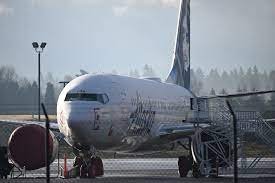
According to a preliminary assessment provided by the National Transportation Safety Board on Tuesday, 6 February 2024, four bolts that were used to secure the panel that ultimately blew off an Alaska Airlines plane during a flight last month were removed from Boeing’s plant in Renton, Washington, and do not appear to have been replaced.
According to Boeing’s records, the panel, also called a door plug, was opened to fix faulty rivets on the fuselage of the aircraft. Who took off the bolts holding the door plug in place was not mentioned in the report. However, the safety board reported that once the rivets were fixed and the door was reinstalled on the aircraft, it seemed that some of the bolts had not been replaced.
The N.T.S.B. sent a picture of the door plug taken after it was replaced, but before the inside was restored as proof. Three out of the four bolts seem to be missing in the picture. There is insulation covering the place of the fourth bolt.
As per the report, on September 19, 2023, “a text message between Boeing team members” had the image attached to it. After the rivet rework was finished that day during second shift operations, the Boeing staff “were discussing interior restoration,” the report stated.
According to the safety board, there is no evidence of the plug being opened again after it was taken out of Boeing’s facility. At the end of October, the aircraft was delivered to Alaska Airlines.
The investigation focuses further attention on Boeing, which has been working feverishly for weeks to contain the incident’s aftermath. It also raises new concerns about whether Boeing took sufficient steps to enhance safety following two catastrophic 737 Max 8 disasters in 2018 and 2019.
It also provides important information regarding why the door plug came loose soon after Portland International Airport in Oregon saw the takeoff of Alaska Airlines Flight 1282.
“Whatever final conclusions are reached, Boeing is accountable for what happened,” stated CEO Dave Calhoun in a statement. He went on, “An incident like this must not occur on an airplane that leaves our factory.”
“We only need to provide better service to our clients and their passengers. We are putting our extensive plan into action in order to boost stakeholder confidence and quality.
The N.T.S.B. ruled out additional explanations for the improper placement of the door stopper.
According to the report, Spirit AeroSystems, a Boeing supplier located in Wichita, Kansas, which produces Max fuselages, received the piece in May after it was constructed in Malaysia in March.
The safety board reported that Spirit had noticed a little problem with the door plug’s “seal flushness,” but the report also stated that Spirit had not reported any other quality issues with the plug and that no additional production work was necessary as a result of the issue.
“We remain focused on working closely with Boeing and our regulators on continuous improvement in our processes and meeting the highest standards of safety, quality, and reliability,” stated Spirit’s spokesperson, Joe Buccino.
The report stated that on August 20; the fuselage was delivered to Boeing and arrived at the Renton facility on August 31.
There, on September 1, the damaged rivets, which are frequently used to attach and fasten sections on airplanes, were noted.
Workers at Spirit AeroSystems in Renton finished the repairs after removing the plug to gain access to the rivets.
Additionally, Oklahoma City installed wireless internet equipment on the aircraft after it was delivered to Alaska Airlines, and this was done from November 27 to December 7.
However, the contractor responsible for that work, AAR, stated in the report that it had “modified approximately 60” Alaska Airlines 737 Max 9 aircraft and that it had not needed to remove any door plugs in order to accomplish that work.
The safety board stated that it would keep examining the paperwork that was used “to authorize the opening and closing” of the door plug as part of its ongoing inquiry.
The Federal Aviation Administration grounded several Max 9 aircraft as soon as possible in response to the Alaska Airlines incident, which caused severe disruptions to United Airlines and Alaska Airlines flight schedules for several days.
Following the release of the safety board’s assessment on Tuesday, 6 February 2024, the FBI made a statement saying, “This incident should have never happened, and it cannot happen again.”
Additionally, the F.A.A. has permanently curtailed Boeing’s audacious plans to boost the production of all Max jets, leaving the business uncertain.
Instead of producing 50 aircraft per month next year and 42 this year, the corporation will probably continue to produce 38 aircraft per month for some time. Citing the event and the need to prioritize safety, Boeing officials refrained last week from offering a financial outlook for the year.
In a rare move, enraged airline executives have openly criticized Boeing and expressed doubts about its ability to deliver the planes they purchased on schedule.
As a result of the tragedy and its aftereffects, Boeing, one of the two biggest aircraft manufacturers in the world, finds itself in the familiar position of attempting to manage a crisis with unknowable financial and reputational repercussions.
The firm invested billions of dollars to make its planes safer and rebuild its reputation just 5 years ago, following the deaths of over 350 people in two separate Max 8 crashes. A defect in the flight stabilization mechanism of the aircraft was the cause of those crashes.
Boeing is working quickly to convince lawmakers, regulators, and customers that it is solely focused on enhancing quality control since it is once again trailing behind. Spirit in Wichita was visited by Mr. Calhoun. Additionally, Boeing organized a gathering where workers at its Renton plant took a day off to attend workshops focused on quality.
Additionally, the company has promised to pay workers “for speaking up to slow things down if that’s what’s needed.”
Former safety board and F.A.A. accident inspector Jeff Guzzetti said Boeing needs to make significant adjustments, one of them being reorienting its emphasis from financial performance to safety.
“This report adds another straw to the camel’s back given the totality of Boeing’s recent troubles, beginning with the two 737 Max accidents and continuing into the production problems of other Boeing models,” the speaker stated. Boeing is not able to take on any more straws, in my opinion. Both the F.A.A. and they are aware of this.
Boeing announced on Sunday, 4 February 2024 that, despite its best efforts to fix the issue, a supplier discovered a fresh issue with the fuselages of several hundred 737 Max aircraft last week. “Two holes may not have been drilled exactly by our requirements,” the supplier discovered.
A Spirit representative said that a team member had discovered a problem during the last week that did not adhere to engineering standards, even though he did not identify the supplier. According to Boeing, the issue will necessitate reworking roughly fifty aircraft, which will postpone the delivery.
Spirit AeroSystems CEO Patrick Shanahan announced during a Tuesday analyst call that the company was going to increase both its own and Boeing’s inspection output.
The senior officer of the Federal Aviation Administration, Mike Whitaker, informed a House panel on Tuesday, 6 February 2024, that the agency would increase its ground-based presence to oversee Boeing’s aircraft production.
Mr. Whitaker said, the Aviation Subcommittee of the Transportation and Infrastructure Committee, “Going forward, we will have more boots on the ground closely scrutinizing and monitoring production and manufacturing activities.”
The regulator has initiated an investigation into Boeing’s adherence to safety requirements, in addition to restricting the company’s expansion in production. The audit, which Mr. Whitaker said would take six weeks, and also started to examine the company’s Max manufacturing. He stated that the agency had sent roughly two dozen inspectors to Boeing, and roughly six to Spirit.
Discover more from Campus News
Subscribe to get the latest posts sent to your email.