

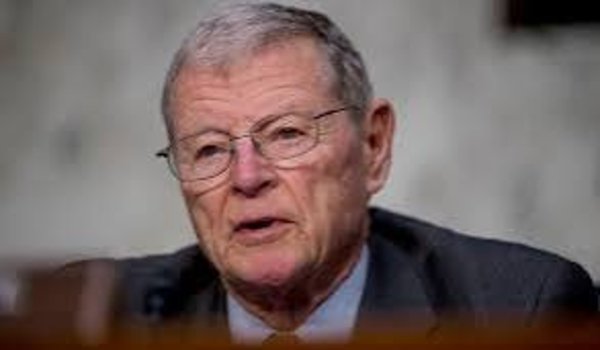
Republican Senator James Inhofe, Who Denied Climate Change Dies at 89
By Reporter 2
Former Senator James Inhofe, who went to great efforts as a senator to deny that human activity is exacerbating climate change, died on Tuesday, 9 July 2024 in Tulsa, Okla at the age of 89. His death, in a hospital, was announced in a statement by his family, which said the cause was a stroke.
Mr. Inhofe (pronounced IN-hoff), the son of an insurance executive, was a tenacious, litigious Tulsa businessman in his 20s and early 30s who, like Mr. Trump, made and lost fortunes in ambitious real estate, land development, and insurance deals that coincided with the start of his political career half a century ago.
After a decade in Oklahoma’s Legislature (1967-77), during which he lost campaigns for Governor and a seat in Congress, Mr. Inhofe became three-term mayor of Tulsa (1978-84), before serving seven years in the House of Representatives (1987-1994) and gaining his Senate seat in a special election. He was re-elected four times, in 1996, 2002, 2008, 2014, and 2020, after serving as a replacement for two years. He opted to leave two years into his fifth full term and retire in early January 2023.
Mr. Inhofe, sometimes referred to as Capitol Hill’s most conservative politician, opposed abortion, L.G.B.T.Q. Rights, health care legislation, and campaign finance reforms, while supporting the death penalty, gun rights, counterterrorism powers, offshore oil drilling, and constitutional amendments requiring balanced budgets and prohibiting flag desecration.
His voting record received largely positive ratings from right-wing organizations such as Freedom Works, as well as massively bad ratings from the American Civil Liberties Union and the National Association for the Advancement of Colored People (N.A.A.C.P). He was chastised for voting against federal disaster relief funding after storms slammed the Gulf and Atlantic coasts, yet he voted in favor of government assistance for victims of tornadoes and other disasters in his home state. He continuously supported a smaller government and robust national defense.
Inhofe’s first explicit attack on a growing amount of scientific evidence on global warming came in a 2003 Senate speech. After that, he became the capital’s most outspoken climate change denier, frequently calling it a hoax manufactured by environmentalists, their liberal allies in the news media, and “extremists who simply don’t like capitalism, free markets, and freedom.”
He expanded on this position in his book, “The Greatest Hoax: How the Global Warming Conspiracy Threatens Your Future” (2012). It included political and economic reasons, but little in the way of significant scientific counter arguments against climate change. “God is still up there,” he declared at one point, and “the arrogance of people to think that we, human beings, would be able to change what He is doing in the climate is to me outrageous.” In one widely documented incident, complete with a photograph, Mr. Inhofe tossed a snowball to a Senate colleague on a chilly February day in 2015, claiming it served as proof that the earth could not be warming dangerously. President Obama made a point of ridiculing the act.
Mining, oil, gas, coal, and utility companies generously contributed to Mr. Inhofe’s Senate campaigns. For many years, as chairman or ranking Republican member of the Senate Environment and Public Works Committee, he frequently spoke out against the growing scientific consensus that people were contributing to climate change by using fossil fuels. For much of that time, notably during the Obama administration, Mr. Inhofe portrayed the Environmental Protection Agency as an “activist organization” that unfairly burdened businesses with rules. When Republicans regained control of the Senate after the 2014 elections, he was appointed head of the Environment Committee, and he continued to assault. He referred to the E.P.A. as “a Gestapo bureaucracy,” launched investigations, and asked for financial cuts.
Mr. Inhofe’s reputation in Washington improved significantly when Mr. Trump was elected in 2016. (Mr. Trump had also referred to climate change worries as a hoax.) Although term restrictions prevented him from continuing as chairman of the Environment Committee in 2017, Mr. Inhofe’s effect on Trump’s environmental agenda became clear quickly. Scott Pruitt, an Inhofe protégé who made his career as Oklahoma’s Attorney General by challenging the Obama administration over environmental rules, was nominated for EPA administrator. Mr. Inhofe offered him a glowing introduction in the Senate, which approved his appointment 52-46.
During Barack Obama’s Presidency, he criticized the Environmental Protection Agency as an “activist organization” that unfairly taxed businesses. Many of Mr. Inhofe’s former employees went on to work at the White House and in the leadership of the Environmental Protection Agency. Much of Mr. Trump’s environmental agenda, including repealing the agency’s clean air and water laws and withdrawing from the Paris climate-change pact, was modeled after Mr. Inhofe’s Capitol Hill playbook. Mr. Pruitt seemed to be undermining the agency he led.
Mr. Inhofe did not defend Mr. Pruitt when news reports questioned his ethics, including scheduling taxpayer-paid first-class jet travel and purchasing a $43,000 secure office phone booth. Behind the scenes, he advocated for Mr. Pruitt’s deputy, Andrew Wheeler, a longtime coal lobbyist and Mr. Inhofe’s former general counsel, to succeed him. When Mr. Pruitt resigned, Mr. Wheeler was appointed interim E.P.A. administrator and later nominated by Mr. Trump to be the permanent administrator. The Senate confirmed him.
After Senator John McCain died in 2018, Mr. Inhofe became chairman of the Senate Armed Services Committee, giving him broad authority over defense policy and the Pentagon’s budget. That shifted the panel’s relationship with the Trump administration. In contrast to Mr. McCain’s often critical judgments, Mr. Inhofe frequently praised Mr. Trump’s foreign policy initiatives while deferring to Defense Secretary James Mattis on military challenges.
Mr. Inhofe, like much of the Senate Republican leadership, disagreed with Mr. Trump’s 2018 decision to withdraw American forces from Syria and reduce troop levels in Afghanistan. In the same month, a Senate financial disclosure report revealed that Mr. Inhofe had purchased $50,000 to $100,000 of Raytheon stock, a major defense contractor, a week after Mr. Trump announced that he planned to request a $750 billion increase in the Pentagon budget for the 2020 fiscal year, up from $717 billion. Ethics experts stated that the purchase posed conflict-of-interest concerns.
Mr. Inhofe denied all misconduct. “I am not consulted or involved in any stock transaction,” he stated at the time. “When this came to my attention, I took immediate action to reverse the trade.” On November 17, 1934, James Mountain Inhofe was born in Des Moines as the youngest of four children to Blanche (Mountain) and Perry Dyson Inhofe Sr., an insurance claims adjuster. James and his siblings, Marilyn, Joan, and Perry Jr., attended public schools in Des Moines. When James was eight, his father moved the family to Tulsa, where he was offered a career as an insurance executive.
James was a member of the Tulsa Central High School running team and learned to fly small airplanes, which became a lifelong passion. After serving in the Army, he enrolled at the University of Tulsa and majored in economics. Official biography stated that he graduated in 1959, but when challenged years later, he admitted that he was a few credits short and did not graduate until 1973.
In 1959, Mr. Inhofe married Kay Kirkpatrick. She is survived by his children James Inhofe II, Molly Rapert, and Katy Swan, as well as his sister Marilyn Davis and 12 grandkids. Perry II, a fourth child, perished in a plane disaster in 2013. Perry Inhofe Sr. died in 1970, and his children inherited holdings in Mid-Continent Casualty, which their father helped build. James and his brother Perry Jr. rose to the position of principal. Perry Jr. gained control of Mid-Continent in a stock swap in 1979, while James purchased a spinoff, Quaker Life, which later failed. The family was interrupted by lawsuits, and James eventually received a $3 million settlement from Perry in 1990.
James, who first became involved in Oklahoma Republican politics in the mid-1960s, served in the State House of Representatives from 1967 to 1969 and the State Senate from 1969 to 1977. He was a popular mayor of Tulsa, going unopposed for his second term and winning 59% of the vote for his third. When Representative James R. Jones, a Democrat, resigned to seek the Senate in 1986, Mr. Inhofe easily won his seat. Mr. Inhofe gained the seat after Senator David Boren, a former Oklahoma Governor, resigned in his third term to become President of the University of Oklahoma in 1994.
Mr. Inhofe’s escapades as one of Congress’ few licensed pilots garnered widespread notice. He traveled throughout Oklahoma in his private plane to campaign. To mark the 60th anniversary of Wiley Post’s solo circumnavigation, he and three other pilots flew a Cessna around the world in 18 days in 1991. He also claimed to have 11,000 hours of flight time. Mr. Inhofe, 75, landed his Cessna on a blocked runway at a South Texas airport in 2010, scattering construction workers. No one was wounded, but the construction supervisor and the airport manager reported the event to the Federal Aviation Administration. Mr. Inhofe was ordered to complete four hours of remedial flying instruction in place of penalty.
Read Also: Universities without Electricity – Owei Lakemfa
Discover more from Campus News
Subscribe to get the latest posts sent to your email.